
Ecosystem Mapping for Food Security
Helping foundations see their complete food assistance landscape
Complete Provider Data
When evaluating funding opportunities, having detailed information on every provider in your region—not just current grantees—enables more informed decisions. FastRoots documents program types, hours, service areas, languages, dietary accommodations, and more.
THE OPPORTUNITY
See Your Complete Food Assistance Landscape
Your region's food assistance ecosystem is complex. Understanding it fully takes time and resources you may not have.

Geographic Intelligence
Where are services concentrated? Where are the gaps? Our mapping tools visualize provider distribution across your region, revealing patterns that inform strategic planning.

Ecosystem Analysis
Beyond data collection, we analyze service capacity, identify underserved areas, and surface coordination opportunities. You receive actionable insights, not just a database.

HOW IT WORKS
From Data Collection to Strategic Insights
Identify Together
FastRoots collaborates with your team to identify every documented food assistance provider in your region, including organizations outside your current portfolio and those not affiliated with the regional food bank network.

Research & Verify
We collect data through public sources and direct provider outreach: program types, hours, languages, dietary accommodations, food sources, mission, and more. You don't chase the information; we do.

Analyze & Map
Your foundation receives an interactive mapping tool with filterable data, geographic analysis, and strategic observations. Conduct due diligence, identify gaps, and see your ecosystem at a glance.

What Happens Next
Your ecosystem map stays current through the channels that work for you: your staff can update records directly, providers can submit their own changes, and FastRoots can conduct quarterly verification sweeps. And when you're ready, your map can become a public "find food" tool for your community.
Foundation Partnership
Henderson County, North Carolina
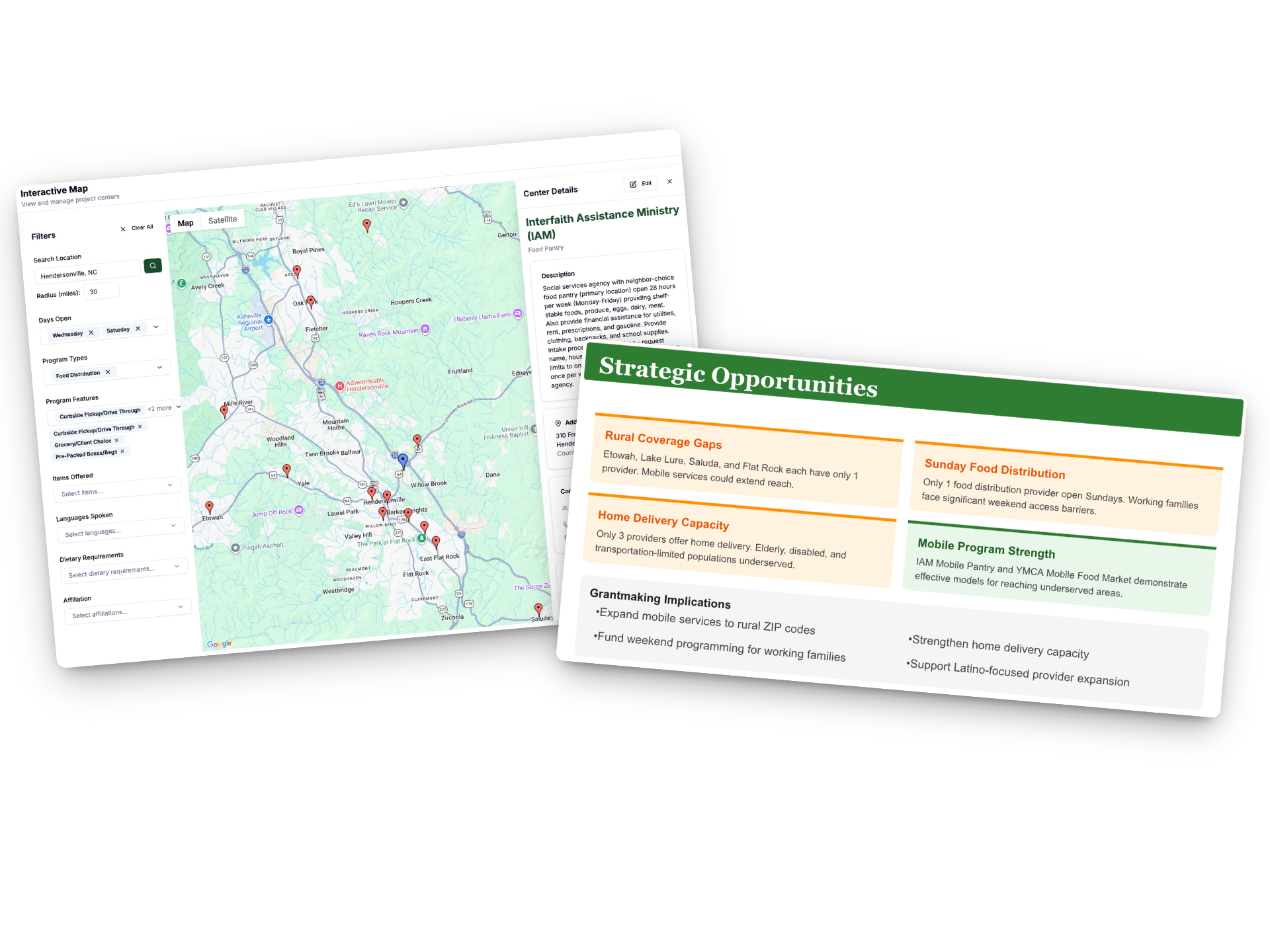
In partnership with the Community Foundation of Henderson County, FastRoots documented the region's complete food assistance ecosystem with interactive mapping—40 providers across multiple program types and service models.
CASE STUDIES
Results in the Field
Key Deliverables
40 provider profiles with detailed operational data (hours, languages, dietary accommodations, registration requirements, service capacity)
Capacity analysis showing 249 weekly hours of food distribution access, with 4 high-capacity providers accounting for 55% of total availability
Interactive mapping tool for filtering by program type, location, language, and service features
Geographic distribution analysis revealing service concentration in Hendersonville and gaps in rural areas.
Service gap identification including limited Sunday availability, home delivery scarcity, and weekend access barriers
Strategic observations positioning the Foundation for data-informed analysis of the needs of its service area and a more complete understanding of the impact of its grantmaking decisions
"FastRoots compiled detailed profiles on 40 food assistance providers in Henderson County. Now our board and committees use the interactive map to identify opportunities and encourage collaboration with grant partners."
Senior Program Officer
Community Foundation of Henderson County
DISASTER RESPONSE
Hurricane Helene Relief Coordination
Following Hurricane Helene, FastRoots built a custom mapping and coordination platform for three food assistance organizations operating across a 12-county region in Western North Carolina.
45
Relief Centers Mapped
12
Counties Covered
106K+
Meals & Food Boxes
1st
Regional Impact Report
"Instead of working in silos, the three grantee organizations used shared data to see each other’s service areas and coordinate distribution. It's a model we hope to see in future recovery grants."
Director, Long Term Recovery Operations
American Red Cross
“FastRoots gave us real-time visibility into what the other relief organizations were doing. We discovered partnership opportunities we wouldn't have found otherwise."
Executive Director
Equal Plates Project
FAQs
Common Questions
-
Most directories cover many issue areas broadly but lack the depth foundations need for strategic decisions. They also go stale quickly and aren't designed for funders. FastRoots is different: we focus exclusively on food security, we collect detailed operational data, and we provide analysis and strategic observations—not just data. The result is an asset you own, not a public database you query.ion text goes here
-
We do the research so you don't have to. FastRoots identifies every documented food assistance provider in your region through public sources, then verifies and enriches the data through direct outreach to each organization. Your team's role is limited: a kickoff conversation to define scope and a review of the draft deliverables.
-
Beyond data collection, we analyze geographic distribution and service concentration, hours of operation and accessibility patterns, service capacity estimates, coverage gaps by ZIP code, weekend and home delivery availability, and language access. You receive a summary document with strategic observations alongside the interactive mapping tool.
-
Most projects take 6-8 weeks from kickoff to delivery. Timeline varies based on region size and number of organizations, but we'll give you a specific estimate after our initial conversation.
-
After delivery, your ecosystem map stays current through the channels that work for you: your staff can update records directly, providers can submit their own changes, and FastRoots can handle ongoing verification on your behalf. Most foundations choose a combination.
-
Yes. When you're ready, your map can become a public "find food" tool. This positions you as the go-to resource for food assistance in your region, builds community trust, and creates donor cultivation opportunities. The public tool is optional; many foundations start with internal use only.
-
Most foundation partnerships fall in the $5,000–$10,000 range depending on region size and complexity. This includes the complete ecosystem mapping, analysis, and your interactive tool. We're happy to provide a specific quote after learning more about your region.

Ready to See Your Complete Food Assistance Landscape?
Whether you want to see how it works, discuss your region, or just learn more, we're here to help.